Working Group · Namibia
Engagement in Southern Africa
Since 2025, the Namibia working group has promoted professional exchange with the dermatologists of the Dermatology Society of Namibia (DSN).
The working group
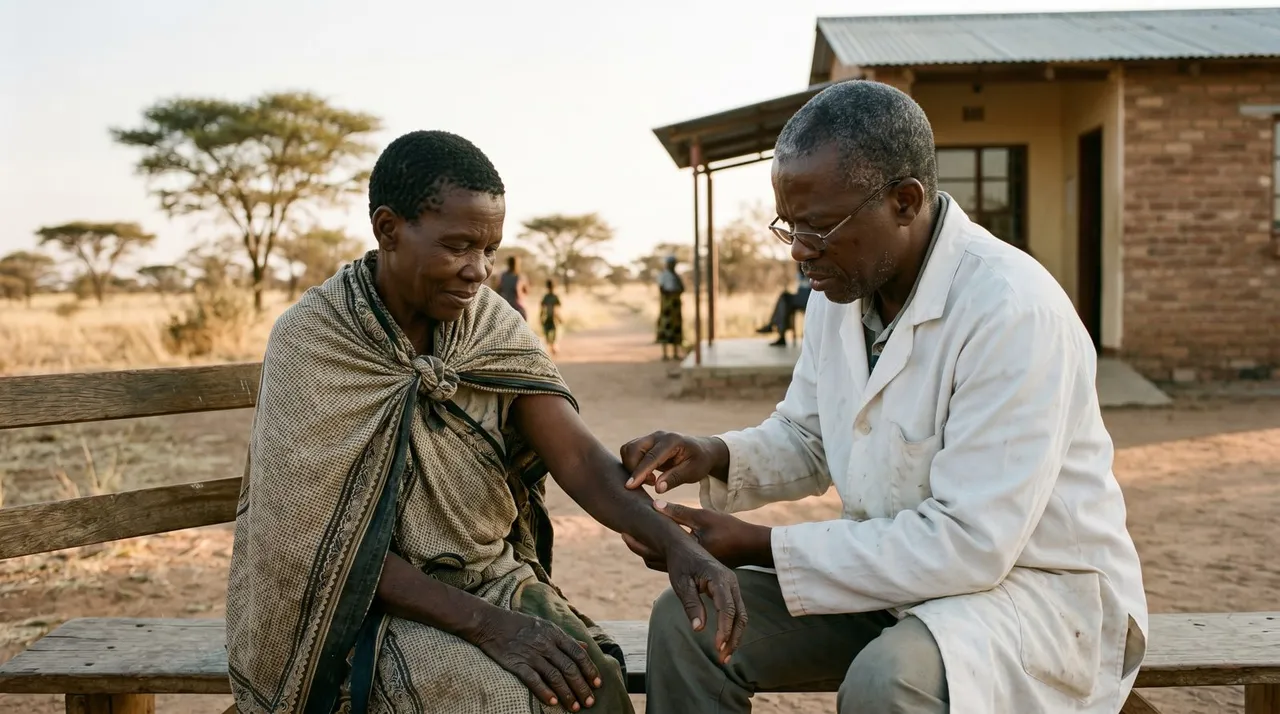
The Namibia working group was founded in 2025 to promote professional exchange with our Namibian colleagues. Its partner is the Dermatology Society of Namibia (DSN). Our work builds on long-standing contacts between individual members of the working group and dermatologists in Namibia, and on their voluntary work in the dermatological training of medical professionals in cooperation with the Ministry of Health of the Republic of Namibia.
Namibia now has trained and very experienced dermatologists, but in their daily work they face a wide range of obstacles and difficulties. These include inadequate facilities and equipment and a glaring shortage of available medicines in the public health system. In addition, only 7 to 10 dermatologists work in Namibia, a country of 3 million inhabitants.
The working group is guided by the wishes and expectations of our Namibian colleagues. One example: our colleague Dr. Niita Haitembu, head of the dermatology department at Windhoek Central Hospital and Lecturer for Dermatology at the Medical School of the University of Namibia (UNAM), wished for academic contacts, and this grew into a cooperation with the Department of Dermatology at the University of Rostock. Dr. Haitembu is an official visiting lecturer at Rostock University Medical Center and regularly supports the dermatology training of students in Rostock on dermatoses in differently pigmented skin with hybrid lectures in the “Global Dermatology” series.
Members of the working group attend the DSN congresses and give talks there. Scientific exchange also takes place through Zoom lectures. There is still great potential here that should be developed further.
We believe that donations in kind, such as surgical instruments or suture material, can help in the short term but never solve a problem at its root. That is why, for our surgery courses, we used our suppliers of instruments and medical products at home to establish contacts with companies in southern Africa. Supply chains for dermatologists in Namibia have since been set up, so that in principle they can buy everything locally that we need in our practices here in Germany. It is not in our hands, however, to influence the structural problems of Namibia’s health system. We should and must leave that to our colleagues there.
Dermatosurgery
At the request of our Namibian colleagues, members of the working group have held basic and advanced dermatosurgery courses several times at Windhoek Central Hospital and Oshakati Intermediate Hospital. At first the members financed these activities privately, later through the Senior Experten Service (SES); today the DSN contributes financially to these assignments.
Our Namibian colleagues are now able to perform larger dermatosurgical procedures such as local flaps and free skin grafts on their own. Access to and maintenance of operating theatres are essential for this. From time to time we support our colleagues in their surgical work with advice on surgical planning, which works without difficulty thanks to modern media.
Albinism
Dermatosurgery is also particularly important for Namibia because the country has one of the highest prevalences of albinism in the world. In June 2026 the Dermatology Society of Namibia therefore ran a nationwide, widely noticed campaign to improve the care of patients with albinism. Following screening and counselling of numerous patients with albinism, selected cases received surgical treatment. In agreement with the Namibian Ministry of Health, members of the working group acted as advisers at Windhoek Central Hospital and at Oshakati Intermediate Hospital. The campaign even received attention in the office of the Prime Minister of Namibia.
After the strong response among the Namibian population, the DSN decided to continue the campaign to improve the care of patients with albinism in the coming years. The colleagues also want to visit smaller rural hospitals to spare patients long journeys. These hospitals, however, lack special dermatosurgical instruments, for example. The DSN therefore wants to purchase such instruments so that they are available for these campaigns in underdeveloped rural regions as well. That costs money, of course. The DSN intends to earn it, for example by offering paid courses at its congresses, such as on ultrasound or other topics of interest. Members of our working group could contribute here as specialists without a fee. In addition, at the suggestion of the ISDT e.V., the working group supports an application by the DSN to the Dermimpact Grant Programme of the International League of Dermatological Societies (ILDS).
Dermatopathology
Developing cooperation in dermatopathology requires a lot of patience. Namibia does not yet have a trained dermatopathologist. Our colleague Dr. Hategekimana, a pathologist at the Namibia Institute of Pathology, is interested in further training in this field and would therefore like to share images of interesting findings electronically. Unfortunately, he lacks the camera equipment to do so. The funds for it are already in the institute’s budget, but the road to actually making the purchase is still very long. We have learned that enduring such difficulties together with our Namibian colleagues, without giving up, has to be part of our work.
Research
Another field of work is currently developing in research. Our Namibian colleagues have asked for support in documenting interesting cases and writing scientific publications. Alongside the daily struggle for basic dermatological care, which at times resembles tilting at windmills, it is anything but easy for them to also do scientific work. Nevertheless, they brought this wish to us on one of our recent working visits. We have understood that in this field we need a great deal of patience and staying power together with them.
Contribute to the Namibia working group?
We welcome colleagues who would like to get involved in Namibia.